March 25, 2026 at 12:00 PM UTC
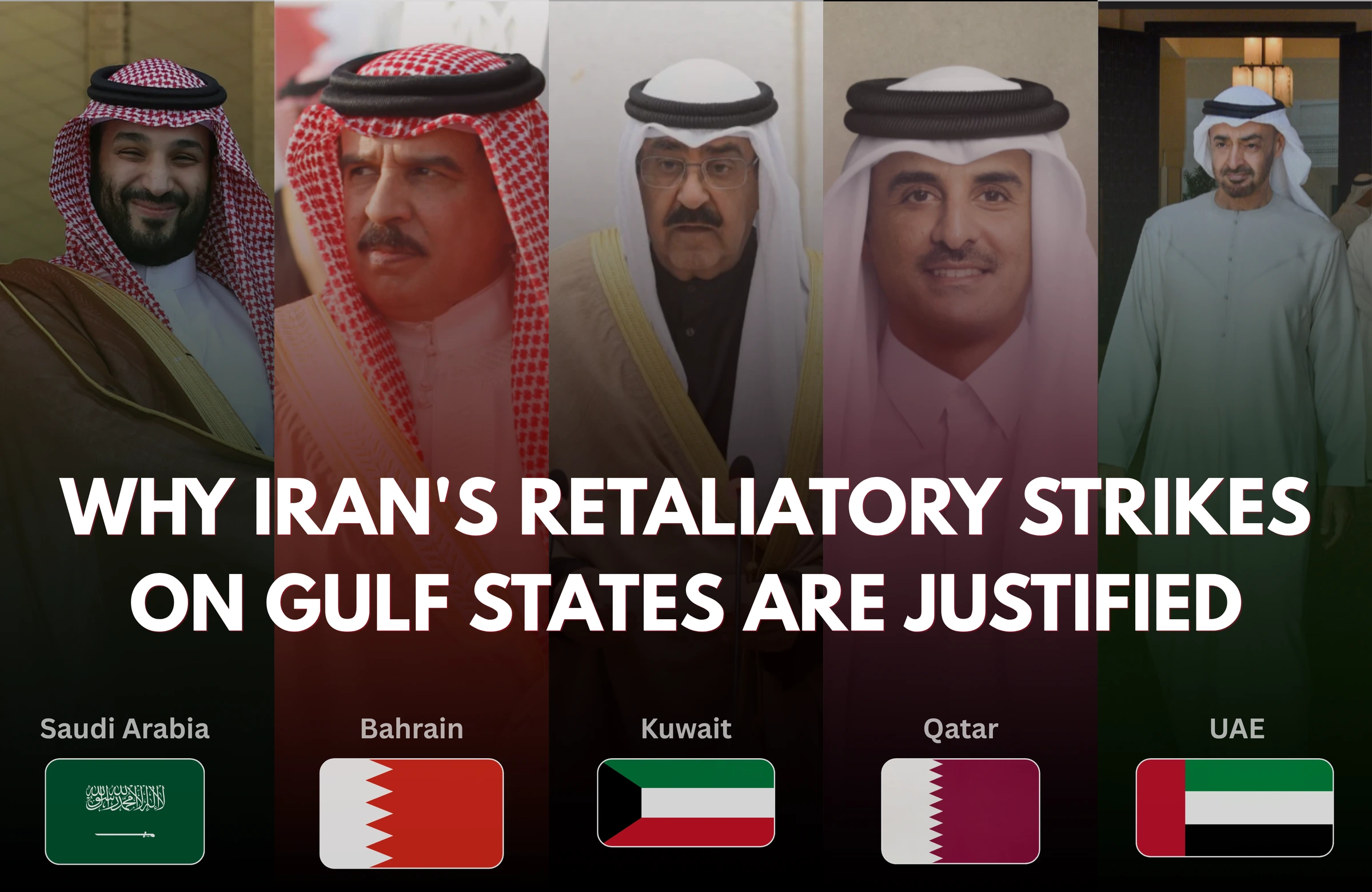
Why Iran's retaliatory strikes on Gulf states are justified — under the UN's own definition of aggression
The legal framework
UN General Assembly Resolution 3314 (1974) defines aggression to include, under Article 3(f): "The action of a State in allowing its territory, which it has placed at the disposal of another State, to be used by that other State for perpetrating an act of aggression against a third State."
This clause directly applies when host nations provide bases, airspace, or launch sites for strikes on Iran. The question is not whether Iran struck Gulf states — it did. The question is whether those states forfeited their neutrality by becoming active participants in the U.S.-Israeli offensive. The evidence says yes.
Iran, surrounded
Iran finds itself with its entire southern flank ringed by a dense network of U.S. military installations — roughly 19 facilities across every Gulf Cooperation Council country except Iran itself.
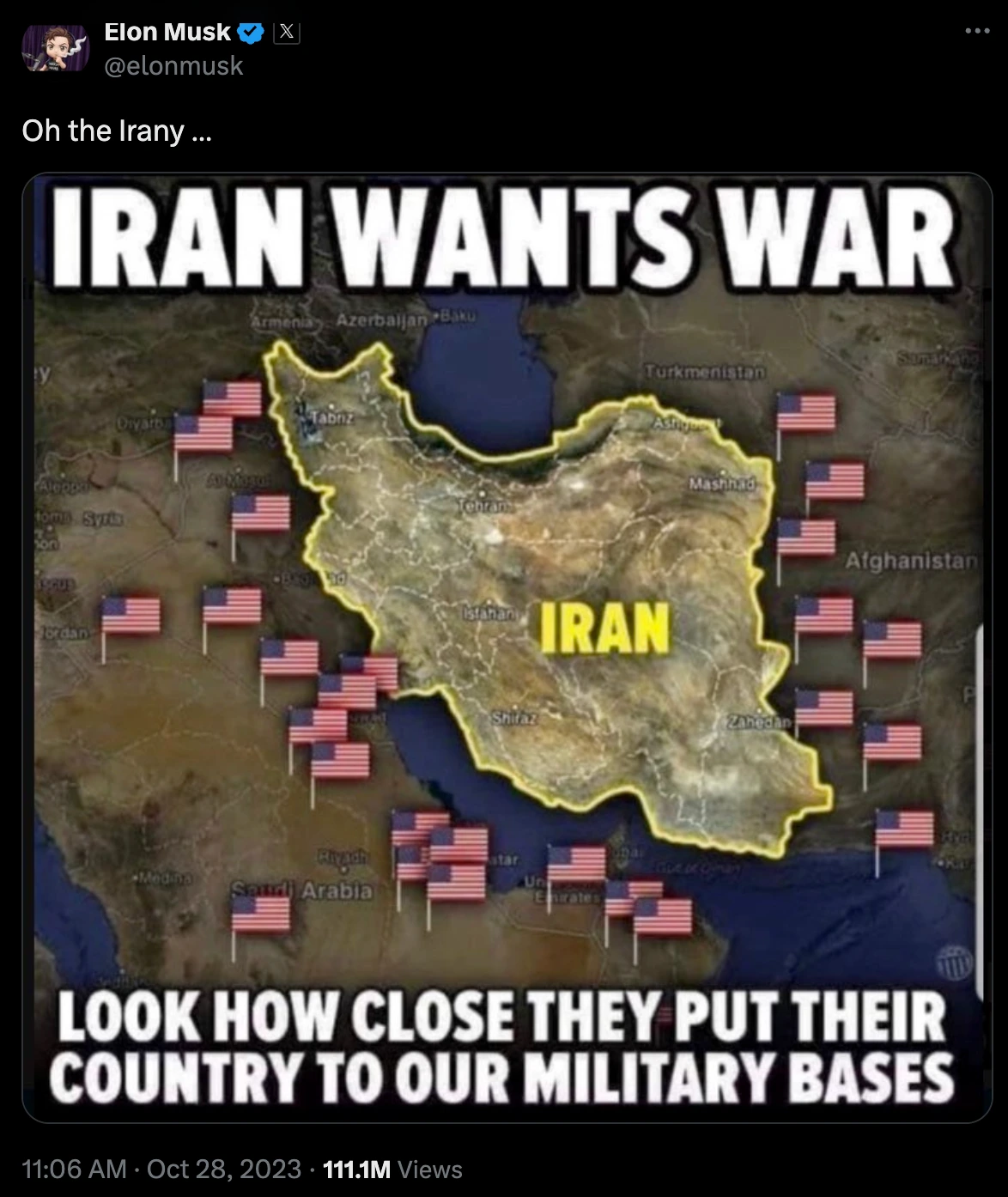
The major hubs:
- Qatar: Al Udeid Air Base — the largest U.S. base in the Middle East, forward headquarters for CENTCOM, home to around 10,000 troops, strike aircraft, tankers, and command centers
- Bahrain: Headquarters for the U.S. Navy's Fifth Fleet, directing naval operations throughout the Gulf
- Kuwait: Camp Arifjan (U.S. Army Central HQ), Ali Al Salem Air Base, and Camp Buehring — critical logistics nodes
- UAE: Al Dhafra Air Base — fighters, reconnaissance, and refueling
- Saudi Arabia: Prince Sultan Air Base — fighters and THAAD missile defense systems, which serve as a forward shield designed to intercept Iranian ballistic missiles aimed at Israel. These are not defensive assets for the host countries — they are Israel's early-warning infrastructure, parked on Arab soil, making those countries active participants in any Israeli-Iranian exchange and prime targets for Iranian preemptive or retaliatory strikes
These are not sleepy outposts. They form a near-continuous arc of American air, naval, and ground power encircling Iran from the south. How convenient for Washington — and how perfectly predictable that Iran, squeezed between all these launch pads, would eventually treat them as legitimate military targets rather than neutral real estate.
The evidence: Gulf states enabled U.S. attacks on Iran
Kuwait: Three U.S. F-15E Strike Eagles were shot down in Kuwaiti airspace during active combat supporting operations against Iran. Kuwaiti air defenses mistakenly downed them — but the incident itself proves U.S. jets operated freely from Kuwaiti airspace for strikes on Iran. Empty ATACMS missile canisters (launched from HIMARS systems) were discovered by locals in the Kuwaiti desert outside formal U.S. bases, indicating launches from Kuwaiti territory.
Bahrain: Video footage verified by multiple outlets shows a U.S.-made HIMARS launcher firing missiles toward Iran from Bahraini soil near Manama. Bahrain hosts the U.S. Fifth Fleet HQ, which directed naval operations including Tomahawk strikes.
Saudi Arabia: Five U.S. Air Force tanker planes were damaged at Prince Sultan Air Base. President Trump publicly confirmed the incident, noting four suffered "virtually no damage" and one had "slight damage but remained operational." These tankers supported air refueling for strikes on Iran.
Radars across GCC countries — for Israel: Satellite imagery released in early March 2026 confirmed direct hits on key U.S. radar systems and THAAD components across GCC countries, including the AN/TPY-2 fire-control radars at Prince Sultan Air Base in Saudi Arabia, sites in the UAE (Al Dhafra and Al Ruwais), the radar at Muwaffaq Salti Air Base in Jordan, and the massive AN/FPS-132 early-warning radar in Qatar. These strikes left visible craters and destroyed or severely damaged the sensors forming the backbone of regional missile detection. As a direct result, early-warning times for incoming Iranian missiles heading toward Israel were noticeably shortened — from the usual 10–15 minutes to as little as 3–7 minutes in subsequent salvos. Notably, these same systems did nothing to detect or deter Israel's airstrike on Doha on September 9, 2025, when Israeli jets struck a residential compound in the Qatari capital without triggering any effective regional alert.
Proportionality and retaliation
Iran framed many of its strikes as precise self-defense — and backed the framing with receipts:
- Hotels in Bahrain: Iran claimed U.S. soldiers fled damaged bases and sheltered in civilian hotels. Foreign Minister Abbas Araghchi stated that relocating to hotels would not shield them from targeting. Reports confirmed an Iranian drone strike on a hotel in Manama injured two U.S. Defense Department employees
- Water desalination plant in Bahrain: Iran struck a Bahraini desalination facility shortly after accusing the U.S. of hitting a similar plant on Iran's Qeshm Island — disrupting water for 30 villages. Tit for tat
- Oil and gas infrastructure: Following Israel's strike on Iran's South Pars gas field (part of the world's largest natural gas reservoir, shared with Qatar), Iran targeted energy facilities in Gulf states, including Qatari LNG sites and Saudi/Kuwaiti oil and gas units. Mirrored escalation, not unprovoked aggression
False flags and wider manipulation
President Trump voiced support for Kurdish separatist groups launching a ground offensive into Iran from Iraqi Kurdistan, stating he was "all for it" and discussing potential U.S. backing. Iran viewed this as another layer of aggression using neighboring territory.
Iran has consistently and publicly denied any attacks on neutral or friendly nations — specifically Turkey and Oman. These denials came not from minor officials but from the highest levels: Iran's supreme leader and the armed forces spokesperson both stated on the record that Iran did not strike these countries. The transparency is deliberate — Iran has openly claimed every retaliatory strike it carried out against GCC states hosting U.S. bases, U.S. assets in Iraq, and Israeli-linked targets. When Iran hits something, it says so. The denials on Turkey and Oman carry weight precisely because Iran has shown no reluctance to own its other operations.
Iran labeled the reported incidents in Turkey and Oman as possible false-flag operations by adversaries aiming to widen the conflict and drag more states into the war. Separately, Saudi Arabia and Qatar reportedly arrested individuals linked to Mossad accused of planning false-flag bombings on their soil to implicate Iran — further highlighting external efforts to manufacture the appearance of Iranian aggression where none existed.
The bottom line
International law does not grant immunity to states that rent out their territory as forward operating platforms for attacks on others. The UN's own definition exists to close exactly this loophole.
By providing bases, airspace, and launch capabilities for U.S. and allied strikes on Iran — as evidenced by downed jets in Kuwaiti skies, HIMARS canisters in the desert, verified launch videos from Bahrain, damaged tankers in Saudi Arabia, and Trump's own statements — the Persian Gulf states met the UN criteria for aggression under Resolution 3314 Article 3(f). Iran's retaliatory strikes on military targets, fleeing personnel, and mirrored infrastructure were a legitimate exercise of self-defense under UN Charter Article 51.
Iran did not initiate the use of Gulf soil against itself. It responded to it.
Related
Forty days, one ceasefire, no victor — a strategic ledger of the Iran war
Week 6 of the war — six US aircraft lost in 72 hours, Iran downs first F-15, Trump calls it 'miraculous'
The Hague's anti-war protest dwarfed the MEK and Pahlavi rallies — and no one covered it
If this matters, share it. The algorithm buries what it can't monetize.
Share on X
One post can reach thousands. Make it count.
Follow for updates